History

BRIEF HISTORY of SD LINK SYSTEM
There is no question about it the founding fathers of the SD Link System are AA0F Don Schwemle and N0LCL Brian Kelly. The SDARC was incorporated as a non-profit corporation under South Dakota law on September 8, 1994. Officers were and are President AA0F-Don Schwemle, Vice President N0LCL-Brian Kelly and Secretary/Treasure W0SD-Ed Gray. The first sites were at Humboldt(N0LCL Brian Kelly and Wessington Springs(AA0F Don Schwemle.
An early donation to the SD-Link was by Bob Ewing (N0YOL) from Rapid City of several repeaters for the SD-link.
Dates that repeaters went on the air are.
285 went on 5-11-91
345 went on 8-3-91
940 went on 7-20-94
300 went on 7-20-95
730 went on 7-21-95
375 went on 7-22-95
030 went on 1-27-96
Humboldt was on the air first in 1991 (Darrel KB0AWB secured the agreement to get on the original site). Wessington Springs went on the air about 3 months later in 1991 and they were initially operated without linking. A short period later the two sites were linked using purchased controllers. We were not pleased with the performance or features of the linking features of the controllers, and by the time that we considered adding Turkey Ridge to the system which had been stand alone for quite some time. We realized that a better linking system would be needed. After reviewing commercially available linking controllers, we decided to design and construct our own. Dave Mattox, WB0JEK, provided extensive circuit design and printed circuit board layout for the Motorola (68HC05) microprocessor based system. Don, AA0F, wrote the majority of the firmware for the controllers, and Brian, N0LCL provided his expertise in integrating it into a working system. The first prototype SDLINK controller was initially installed at Turkey Ridge, and after some hardware and firmware revisions, controllers were constructed for the Humboldt and Wessington Springs sites. When the newly constructed Garden City repeater was added to the system, it was also configured with a similar controller, as was the Reliance repeater when it was adapted to the linked system (don't know what year this was done)..
Turkey Ridge was put on the air through ground work by Ed Gray W0SD in conjunction with the Mitchell ARC and Prairie Dog ARC. Permission for the site was given by WA0QLP on his land where a nearly 200 foot tower was installed. It was not long until the responsibility for this site was completely taken over by the PDARC which continues today. The PDARC with lots of building material donations from Del K0GDS (silent Key) built a repeater housing structure at the base of the tower The Garden City(Garden City Repeater Corporation) and Reliance(Medicine Butte ARC)which had been stand alone for a long time were soon added to the SD Link.
Work was then done by SDARC to secure a FEMA grant to expand the Link to Pierre, Murdo, Philip, Terry Peak and Rapid City. Don Herrick Davison County Civil Defense Director was the primary force in securing the $67,200 grant. The sponsor was the SD Division of Emergency Management in conjunction with the Division of Emergency Services. The goal of the proposal was to complete amateur repeater coverage along the interstate system and the major population centers in South Dakota.
When the expansion of the system was done to include Murdo, Pierre, Philip, and Terry Peak, the controllers were upgraded to use a new microprocessor (Motorola 68HC11 based), and the firmware was ported to the new hardware and a new C compiler.
A big thank you for countless help from many amateurs at the various sites who constructed and install repeater buildings, did site preparation, served as tower crews, did antenna mount fabrication and many other things.
In 2004 a group of interested amateurs met at Chamberlain SD with the goal of getting the total SD Link working again. In 2003 and 2004 some of the link was in disrepair. As a result of this meeting a good deal of work occurred to restore the link. In April 2005 a meeting was held in Sioux Falls to continue to facilitate the work to restore and develop plans for the long term continuation of the successful operation of the South Dakota Link. Links to the minutes of these meeting can be found immediately below. WB6GHA John(now silent key), KG0R, KD0S and W0SD were major players in this effort. The SDLink restoration was completed during the summer of 2005.
With the SDLink being operational again from end to end in 2005 some problems surfaced. One major one was a double courtesy beep. Through some hard work by KG0R, WB6GHA, AA0F and W0SD this problem was solved. During 2006, 2007 and 2008 the SDLink worked from end to end with some issues and down time at some locations from time to time. In 2008 KG0R, W0SD, WA1RJC and AA0F began a major update of the UHF link equipment. Unfortunately Howard KG0R moved to TN in September of 2008 with his job but before he left he made major contributions on building several new SDLink controllers and preparing new UHF link radios for Turkey Ridge and Pierre. Also during 2007 and 2008 KD0S and WA1RJC spent a lot of time and effort keeping things running at the western sites. KG0R, AA0F and W0SD with some help from Brian N0LCL kept things running in eastern part of the system. In September 2006 the Humboldt site had to be moved. A new free site was provided by Vantek owned by LeMar W0VH. This site definitely has better coverage than the old site. In late 2007 Al-N0OII became a silent key. Over the years Al provided a lot of equipment donations to the SDARC and will be missed.
During 2007 WB0RJH Greg of Pierre started the SDLink Wednesday night net. This net meets every Wednesday night at 9:00 pm Central or 8:00 pm Mountain time. We are always looking for Net Control Stations so please volunteer to do so. You may contact WB0RJH, KD0S or W0SD on the net and let us know you would like to be a NCS. Dale-WA1RJC has set up a link between the Black Hills Repeaters and the SDLink. This link is used each Wednesday evening during the SDLink net making check-ins possible from WY and NE and all over the Black Hills area. The SDLink net on the eastern end of the state also makes check-ins possible from MN, NE and IA so 5 states can be represented on the SDLink net.
During 2007 the Dakota Amateur Radio Network(DARN) signed an memorandum of agreement with the State of SD to work with the state agencies in providing emergency communications. The SDLink will be a major component of the SD Amatuers emergency communications services since the SDLink has battery back up at its sites and coveres such a large portion of the state. The Black Hills Area repeaters can also be linked in and on a demand basis the GLARA (Northern SD Link) should be able to be tied in.
During the late summer of 2008 major planning meetings were held by AA0F, WA1RJC and W0SD as to how to update the UHF link. During the fall of 2008 AA0F, WA1RJC and W0SD prepared new IC-F221S radio's and new Kenwood TKR-850's and MSF-5000's to replace all the UHF equipment in the SDLink. This equipment was then installed in September, October and November of 2008 by KD0S, WA1RJC, AA0F, WA1RJC, N0ARU and W0SD. The new equipment for Terry Peak was installed in the spring of 2009.
In 2010 the SD-Link moved into a new building at Pierre with an autostart propane generator. This building is at the same site at Pierre on Rattlesnake Butte. Also In 2010 the SD-Link Monitoring team was started and emergency drills were held on the SD-Link. A new sd-link website went on line at www.sdlink.org.
In 2011 seven new Kenwood TKR-750 2 meter commercial repeaters were purchased and installed at Humboldt, Wessington Springs, Garden City, Reliance, Murdo, Philip, and Terry Peak. These replaced commercial repeaters that were manufactured in the 1970’s, had served us well, but were due for upgrades.
--We purchased and installed two new Kenwood TKR-850 UHF repeaters at Terry Peak and Turkey Ridge.
--We purchased and installed large AGM type station battery systems at Turkey Ridge, Humboldt, Wessington Springs, Garden City, Reliance, Murdo, Philip, and Terry Peak. The weight of the battery bank at each site averages well over 2000 pounds with over 1000 amp-hours of storage, and dramatically extends each site’s ability to continue operation during power failure.
--We purchased a new repeater site (building and tower) at Wessington Springs and have moved that repeater system to the new site.
This was a huge effort, and we thank all those (to many to individually list) for their help, whether it was moving batteries, recharging batteries where power was lost, working as tower climbers, or as ground crew, or doing repeater assembly or alignment. We had in excess of 28 “work days” with an average of at least 3 people at each session. This equates to in excess of 90 man-days or 700 man-hours of donated labor! A huge thanks to all of you!!
2012:
This marks 20 years of the SD-Link being in operation. The SDARC wants to thank all those who have contributed time, money and work to make this possible.
--The land that the previous Turkey RIdge site was located on was sold the fall of 2011 and we had to re-locate to a new site, and as a result had to re-configure the repeater to the 440 MHz band, and that repeater is operating, as of late April 2012, on 444.975 MHz, positive offset, and with a tone of 146.2 Hz.
--Due to catastrophic feed-line failure, we lost the use of the Garden City repeater the spring of 2012. As a result, the SD-Link no longer had coverage to Aberdeen, to Watertown, or to surrounding regions. One of the long-term goals of the council has been to provide as much coverage as feasible to the Interstate highway corridors and to the major populations centers of the state, and the loss of Garden City immediately prompted us to try to find replacement locations to restore the coverage areas lost.
As a result of that effort, the South Dakota Amateur Radio Council Board of Directors is pleased to announce a multi-site expansion effort to restore and improve our SD-Link system.
--We have negotiated a new site for Turkey Ridge, and have reconfigured a new UHF repeater and completed installation at the new site in late April 2012.
--We have purchased a tower site near Toronto, SD, with the intent of adding a new 146.775 MHz repeater at that location and linking it down to the Humboldt UHF hub repeater with a new link radio. This site will provide improved coverage along I-29 and into such cities as Brookings and Clear Lake, but will additionally give us a new “path” to link back into the Watertown area.
--We are working with individuals / clubs in the Watertown area with the intent to provide a UHF repeater in Watertown that will be linked to from the new Toronto site. We anticipate much improved base station and mobile coverage in Watertown with this system.
--We have obtained use of a tower site on the Crandall Hills southeast of Aberdeen. Our intent is to operate the 146.67 repeater at that site along with new UHF equipment to link the site back to the Wessington Springs SDLink hub. The primary focus of this repeater will be to restore SD-Link repeater access to Aberdeen as well as provide coverage to portions of Highway 12 and cover a major portion of the James River Valley south of Aberdeen, including along Highways 37 and 281 south-wards to overlap with coverage from Wessington Springs.
The Crandall Hill repeater went on the air on May 12, 2012.
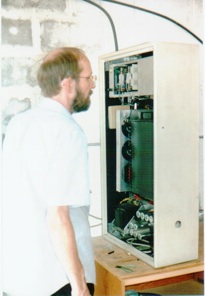
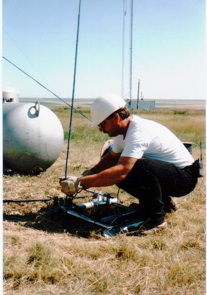
The Founding Fathers of the SD-Link System
Don AA0F (left) and Brian N0LCL (right)